Every year on October 10, World Mental Health Day shines a spotlight on the importance of mental health globally. The theme for 2025, “Access to Services – Mental Health in Catastrophes and Emergencies,” highlights the urgent need to ensure mental health care reaches those affected by disasters, crises, and emergencies. These situations whether natural calamities, conflicts, or pandemics devastate communities emotionally and mentally, often resulting in long-term psychological disorders if timely support is not provided (World Federation for Mental Health, 2025).
The Global Mental Health Landscape in Emergencies
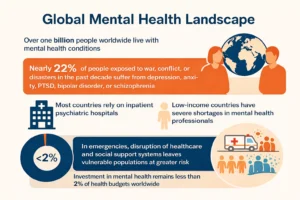
Globally, over one billion people live with mental health conditions, and emergencies exacerbate these numbers drastically. According to the World Health Organization (WHO), nearly 22% of individuals exposed to war, conflict, or disasters in the past decade suffer from depression, anxiety, post-traumatic stress disorder (PTSD), bipolar disorder, or schizophrenia. Despite rising needs, access to mental health and psychosocial support services (MHPSS) remains insufficient worldwide. Low-income countries face severe shortages in mental health professionals, with some countries having fewer than 10% of affected people receiving care (WHO, 2025; World Federation for Mental Health, 2025).
Investment in mental health remains less than 2% of health budgets globally. Community-based care models that integrate mental health into general healthcare are being promoted but still lag behind, with most countries relying on inpatient psychiatric hospitals. In emergencies, the disruption of healthcare and social support systems leaves vulnerable populations such as those with severe mental illnesses at greater risk (WHO, 2025).
Mental Health Challenges and Services in Pakistan
Pakistan faces a mounting mental health crisis exacerbated by socio-political instability, natural disasters, and limited healthcare infrastructure. An estimated 24 million people (around 10% of the population) require psychiatric assistance, yet the country has only 0.19 psychiatrists per 100,000 persons the lowest ratio in the WHO Eastern Mediterranean Region. Mental health disorders contribute over 4% to Pakistan’s total disease burden, with women and children being disproportionately affected (Pakistan Today, 2025; WHO Pakistan, 2025).
Leading mental health disorders include depression, anxiety, PTSD, and substance use disorders. Stigma, lack of awareness, financial barriers, and scarcity of trained professionals significantly limit access to services. Harvard-led research in 2021 exploring mental health care barriers in Pakistan identified key obstacles: low mental health literacy, social stigma, reliance on traditional healers, and insufficient community-based services. The study emphasized the need to increase public awareness, reduce stigma, and expand trained mental health workforce and service delivery across urban and rural areas (Choudhry, 2021; Harvard Global Health, 2021).
Despite challenges, Pakistan has seen promising community initiatives and mental health awareness campaigns. Integration of psychosocial support within emergency response frameworks is gradually improving; however, much remains to be done to meet the escalating mental health needs during disasters, where trauma and psychological distress can spike sharply (WHO Pakistan, 2025).
How to Improve Mental Health Services Access ?
Improving mental health access in catastrophes and emergencies requires both global and locally tailored approaches:
- Policy and Funding: Governments must prioritize mental health in disaster preparedness and response plans, allocating adequate funding and creating inclusive, rights-based mental health laws. This ensures sustainable, quality care for affected populations (World Federation for Mental Health, 2025).
- Community-Based Care: Shifting from institutional to community-oriented mental health models enhances accessibility, reduces stigma, and allows care in less resource-intensive settings. Training lay health workers and integrating mental health into primary health care are key strategies (WHO, 2025; Choudhry, 2021).
- Awareness and Stigma Reduction: Public education campaigns to increase mental health literacy can encourage help-seeking behavior and dismantle harmful stigmas that prevent people from accessing care (Harvard Global Health, 2021; British Asian Trust, 2024).
- Strengthening Emergency Preparedness: Embedding mental health and psychosocial support services (MHPSS) in disaster risk reduction ensures psychological support is part of emergency services, helping people recover more effectively from trauma (WHO, 2025).
- Capacity Building: Training mental health professionals and emergency response workers in psychosocial support and self-care is vital to sustain services during crises (World Federation for Mental Health, 2025).
Lifeline Rehab: Supporting Mental Health with Evidence-Based Care
At Lifeline Rehab, we are committed to addressing the critical mental health needs in Pakistan through evidence-based treatment and comprehensive care. We provide multidisciplinary, client-centered services ranging from psychological assessments to therapeutic interventions for various mental health disorders. Our focus is on making mental health services accessible and effective, especially for those impacted by emergencies and chronic stressors.
As a trusted mental health organization, Lifeline Rehab partners with community programs, health professionals, and policymakers to enhance awareness, reduce stigma, and promote the integration of mental health into broader health and social care systems. By prioritizing scientific research and compassionate care, we strive to improve the mental well-being of individuals and communities in Pakistan.
References
- World Federation for Mental Health. (2025). World Mental Health Day Proclamation: Access to Services – Mental Health in Catastrophes and Emergencies.
- World Health Organization. (2025). Over a billion people living with mental health conditions – WHO report.
- Pakistan Today. (2025). Pakistan faces worsening mental health crisis amid neurological deficit.
- Choudhry, F. R. (2021). Barriers and facilitators to mental health care: A systematic review of Pakistan. Journal of Pakistan Psychological Research.
- Harvard Department of Global Health and Social Medicine. (2021). Mental health research in Pakistan.
- WHO Pakistan. (2025). Mental Health Day celebrations highlight challenges and needs in Pakistan.
- British Asian Trust. (2024). Mental health in Pakistan.
Rana Zeeshan Ahmad
Clinical Psychologist
Lifeline Rehab Islamabad